ELLESadAPT Project
Characterized by high socioeconomic and environmental sensitivity and limited capacity to adapt to climate change, Central Africa is currently ranked among the regions of the world most vulnerable to climate change.
To address these challenges, the ELLESadAPt project, funded by Global Affairs Canada (GAC), is being implemented by a consortium comprising Baastel and Développement International Desjardins (DID) in collaboration with the NGO Noé. Implementation began in December 2023 and will conclude in December 2026. This project primarily aims to strengthen the climate change adaptation of women and ecosystems within the Binder-Léré Protected Areas Complex (CAPBL) – which includes Zah Soo National Park (PNZS) – in Chad and the Conkouati-Douli National Park (PNCD) in the Republic of Congo, while generating benefits for ecosystem and biodiversity conservation.
The project is structured around three components:
- Enhanced conservation of threatened biodiversity and ecosystem services in the two protected areas (PAs) through nature-based solutions (NbS) that strengthen women’s natural resource management capacities to tackle climate change
- Increased adoption of NbS in production systems by women entrepreneurs, yielding additional biodiversity benefits
- Increased adoption of local land-use plans and protected area management plans that are climate-resilient, gender-sensitive, and protect threatened biodiversity
Baastel provided technical leadership to the consortium for the implementation of this project as a whole and particularly contributed its expertise to Components 1 and 3. Over the course of these three years of implementation, our organization provided technical and financial support for the management and logistical, operational, and structural strengthening of the two parks, while carrying out ecological restoration and ecological engineering initiatives within the peripheral zones of both protected areas, enhancing knowledge of climate change and prioritizing adaptation and gender-sensitive nature conservation actions, and strengthening local land-use planning.
Support to Park Management
In Chad and the Republic of Congo, Baastel provided technical and financial support for the management and development of the protected areas through:
- The conduct of in-depth technical studies on specific ecosystems and biodiversity (habitat mapping of the PNCD; an in-depth study of the geomorphology and physicochemical quality of Lakes Léré and Tréné within the CAPBL; a hydrobiological study at the PNCD, among others);
- Capacity building for the teams of each protected area (awareness-raising and training on climate change and adaptation, participatory, inclusive and gender-sensitive management, etc.);
- Development of park infrastructure (construction of staff offices in both parks, as well as a technical workshop at the PNCD headquarters; installation and operationalization of weather stations in both parks);
- Strengthening of strategic planning capacities (development of a community development strategy in Chad; financial support for the land-use planning and management processes of both protected areas; and updating of the IMET assessment for the PNZS).
Over a three-year period, the ELLESadAPt project also funded a portion of the operational and logistical costs of managing the two protected areas, supporting their conservation, ecological monitoring, anti-poaching and community development activities, among others.
Ecological Restoration
In Chad, Baastel has contributed to the restoration of degraded ecosystems using an inclusive community-based approach, covering 400 ha of community forests and 5,400 ha of lake ecosystems.
In the community forests, several pilot initiatives were implemented:
- Support to Village Committee Watch (CVS) groups, notably through the provision of equipment and the organization of various training sessions,
- Raising community awareness about the importance of forest protection and restoration for the future of the communities,
- Improving the visibility of community forest boundaries,
- Establishing protected zones within community forests to promote natural regeneration,
- Reforestation of degraded areas by planting suitable tree species produced in local nurseries.
Several initiatives have also been implemented to contribute to the restoration and sustainable management of Lakes Léré and Tréné:
- Improving the visibility of protected areas
- Providing equipment support to Village Committee Watch (CVS) groups
- Pilot project for lakeshore restoration
Pilot project for the utilization of water hyacinth through three value chains: compost, basketry, and biogas
In the Republic of Congo, Baastel supports the protection and restoration of ecosystems through a range of activities.
First, agroforestry plots dedicated to fuelwood production have been established in five villages. These plots provide direct benefits to local communities while laying the foundations for future sustainable fuelwood production. The initiative is based on a participatory community approach, with the plots managed by and for the communities themselves.
Second, reforestation activities are being implemented to restore gallery forests and re-establish ecological corridors, with the aim of reconnecting habitats and strengthening ecological connectivity.
A nursery has also been established at the park headquarters to produce native tree species and support the implementation of ecological restoration activities.
Finally, an initial hydrobiological study of the Conkouati river, lagoon and lake complex has generated essential baseline data for assessing the ecological condition of these ecosystems and the physicochemical quality of the water. Changes at the mouth of the Conkouati Lagoon are also regularly monitored using drones.
Vulnerability Assessments & Climate-Resilient, Gender-Responsive Land-Use Planning
Baastel accompanied the entire process of integrating climate adaptation and gender considerations into local planning, from vulnerability assessments and participatory diagnostics to the development or revision of land-use planning documents.
In each country:
- A vulnerability assessment was conducted, drawing on downscaled climate modelling, technical assessments of water resources, and complementary qualitative analysis.
- Adaptation measures were then identified through a participatory process involving local communities and protected area managers, and an adaptation report was produced for each country.
This preliminary work provided the basis for supporting climate-resilient and gender-responsive land-use planning processes.
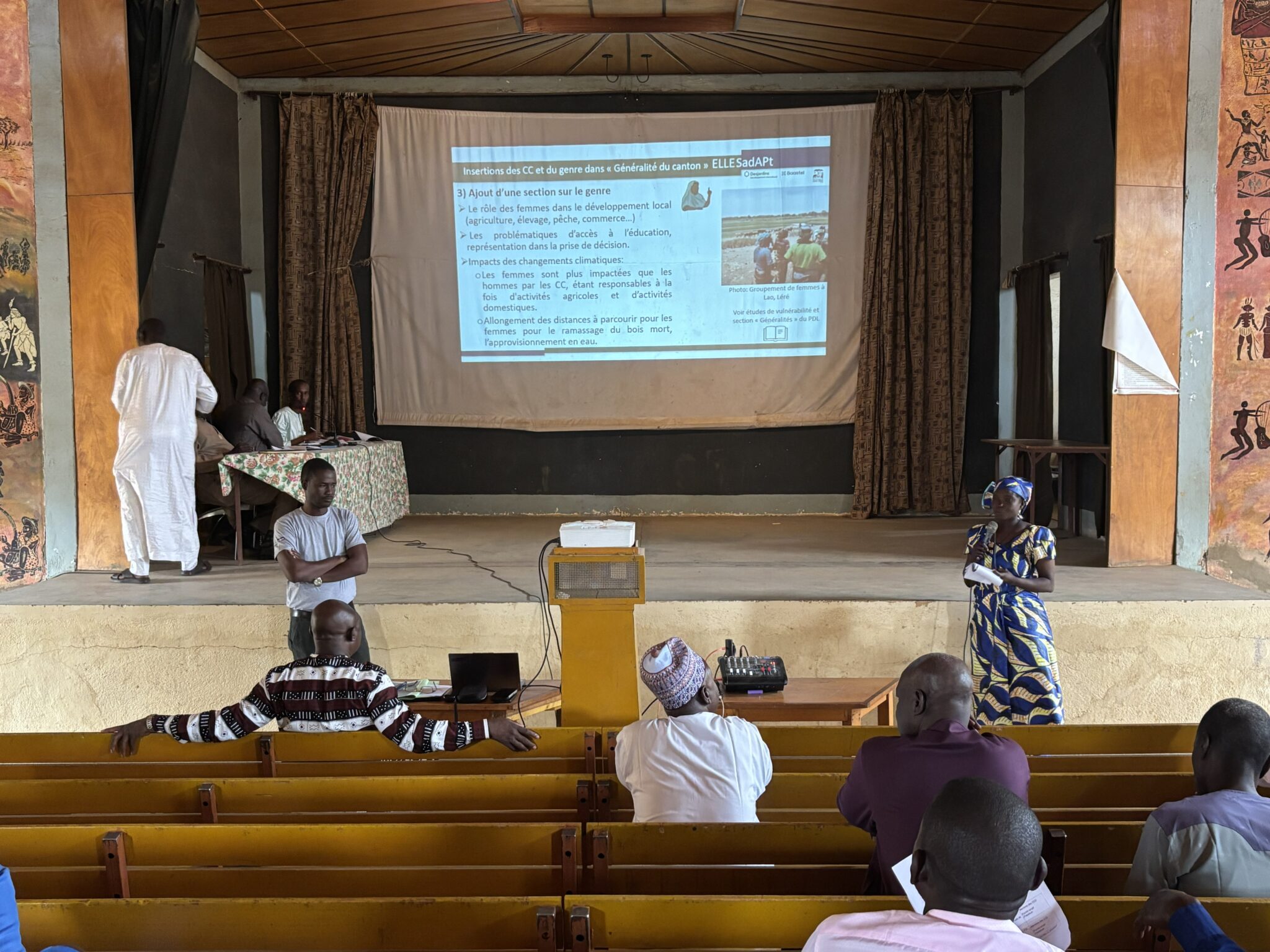
In Chad, Baastel supported the updating of the Local Development Plans (LDPs) for the five cantons bordering the CAPBL. As these plans had reached the end of their validity period, they were updated with Baastel’s support, in close collaboration with the CAPBL Community Development Department, through a capacity-strengthening approach targeting local stakeholders.
The revised plans now incorporate available data on climate change and gender, as well as a climate-resilient and gender-responsive action plan. Various capacity-strengthening tools were also developed for key local planning stakeholders, including a methodological guide, infographics, and posters.
In the Republic of the Congo, Baastel organized two seminars in partnership with the PNCD and the Justice and Peace Commission (CJP), with the specific objective of strengthening the knowledge of key land-use planning stakeholders of the Kouilou Department on climate change, vulnerability, adaptation and gender equality. To support this process, a methodological guide on integrating climate change adaptation and gender considerations into planning was developed.
To further support climate-resilient and gender-responsive planning, six Village Land Development and Use Plans (PDUTVs) were developed in six pilot villages of the PNCD.
Baastel provides technical and financial support to the planning and management processes of both parks, with the aim of ensuring that each protected area has a gender-responsive and climate-resilient Management Plan.
Project Reports and Publications
Vulnerability Assessments & Adaptation
Chad
Rapport de modélisation climatique à échelle réduite – CAPBL
2024 · Rapport · 31 pages
Synthèse du rapport de modélisation climatique à échelle réduite – CAPBL
2024 · Synthèse · 38 pages
Rapport de diagnostic sur les ressources en eau –
CAPBL
2024 · Rapport · 31 pages
Étude de vulnérabilité sur les ressources en eau – CAPBL
2024 · Rapport · 43 pages
Étude de vulnérabilité aux changements climatiques – CAPBL
2024 · Rapport · 117 pages
Synthèse de l'étude de vulnérabilité aux changements climatiques – CAPBL
2025 · Synthèse · 8 pages
Identification et priorisation des options d’adaptation aux changements climatiques – CAPBL
2024 · Rapport · 68 pages
Republic of Congo
Étude de vulnérabilité aux changements climatiques – PNCD
2025 · Rapport · 90 pages
Synthèse de l’étude de vulnérabilité aux changements climatiques – PNCD
2025 · Synthèse · 8 pages
Résultats du processus de priorisation des mesures d'adaptation aux changements climatiques – PNCD
2025 · Rapport · 24 pages
Land-Use Planning and Guidelines
Chad
Guide méthodologique pour l’intégration de l’adaptation et du genre dans les PDL au Tchad
2025 · Guide · 32 pages
Plans de Développement Locaux (PDL) des cantons riverains du Complexe d’Aires Protégées de Binder Léré (CAPBL)
Synthèses des Plans de Développement Locaux (PDL) des cantons riverains du Complexe d’Aires Protégées de Binder Léré (CAPBL)
Synthèse du Plan de Développement Local (PDL) du canton Binder
2026-2029 · Synthèse · 13 pages
Synthèse du Plan de Développement Local (PDL) du canton Gouin
2026-2029 · Synthèse · 11 pages
Synthèse du Plan de Développement Local (PDL) du canton Lagon
2026-2029 · Synthèse · 12 pages
Synthèse du Plan de Développement Local (PDL) du canton Léré-rural
2026-2029 · Synthèse · 14 pages
Synthèse du Plan de Développement Local (PDL) du canton Tikem
2026-2029 · Synthèse · 12 pages
Republic of Congo
Guide méthodologique pour l’intégration de l’adaptation et du genre dans le PDL du Département du Kouilou
2026 · Guide · 24 pages
Plans de Développement et Utilisation du Terroir Villageois (PDUTV) pour 6 villages pilotes du PNCD
Plan de Développement et Utilisation du Terroir Villageois (PDUTV) du village de
2025 · Rapport · 90 pages
Plan de Développement et Utilisation du Terroir Villageois (PDUTV) du village de
2025 · Synthèse · 8 pages
Plan de Développement et Utilisation du Terroir Villageois (PDUTV) du village de
2025 · Rapport · 24 pages
Plan de Développement et Utilisation du Terroir Villageois (PDUTV) du village de
2025 · Rapport · 24 pages
Plan de Développement et Utilisation du Terroir Villageois (PDUTV) du village de
2025 · Rapport · 24 pages
Plan de Développement et Utilisation du Terroir Villageois (PDUTV) du village de
2025 · Rapport · 24 pages
Sensitization Tools & Capacity Building
Pourquoi intégrer l’adaptation et le genre dans la planification locale ?
2025 · Infographie
La vulnérabilité actuelle aux changements climatiques dans le CAPBL
2025 · Poster
Project Pictures
Republic of Congo
Chad

Republic of Congo
Chad